81-year-old Franklin Township Man Alleges He Was Confronted About the Red Make America Great Again
On the morning time of 11 September 2001, Klaus Schwab sat having breakfast in the Park East Synagogue in New York City with Rabbi Arthur Schneier, one-time Vice President for the World Jewish Congress and close associate of the Bronfman and Lauder families. Together, the two men watched i of the nigh impactful events of the next twenty years unfold equally planes struck the Earth Trade Center buildings. Now, two decades on, Klaus Schwab again sits in a front row seat of yet another generation-defining moment in modern human history.
E'er seeming to have a front end row seat when tragedy approaches, Schwab'south proximity to world-altering events probable owes to his beingness i of the nearly well-connected men on Globe. As the driving force behind the World Economic Forum, "the international organization for public-individual cooperation," Schwab has courted heads of land, leading business concern executives, and the aristocracy of bookish and scientific circles into the Davos fold for over fifty years. More recently, he has besides courted the ire of many due to his more recent role every bit the frontman of the Great Reset, a sweeping endeavour to remake culture globally for the express benefit of the aristocracy of the Earth Economical Forum and their allies.
Schwab, during the Forum'southward almanac coming together in January 2021, stressed that the building of trust would exist integral to the success of the Great Reset, signalling a subsequent expansion of the initiative's already massive public relations entrada. Though Schwab chosen for the building of trust through unspecified "progress," trust is normally facilitated through transparency. Perhaps that is why so many take declined to trust Mr. Schwab and his motives, every bit so little is known about the man'southward history and background prior to his founding of the World Economical Forum in the early on 1970s.
Like many prominent frontmen for elite-sponsored agendas, the online tape of Schwab has been well-sanitized, making information technology hard to come up across information on his early history as well as data on his family. Still, having been born in Ravensburg, Federal republic of germany in 1938, many take speculated in recent months that Schwab's family unit may have had some tie to Centrality war efforts, ties that, if exposed, could threaten the reputation of the World Economical Forum and bring unwanted scrutiny to its professed missions and motives.
In this Unlimited Hangout investigation, the past that Klaus Schwab has worked to hide is explored in detail, revealing the interest of the Schwab family, non only in the Nazi quest for an atomic flop, but apartheid S Africa's illegal nuclear program. Especially revealing is the history of Klaus' begetter, Eugen Schwab, who led the Nazi-supported German branch of a Swiss engineering firm into the war every bit a prominent armed services contractor. That company, Escher-Wyss, would utilize slave labor to produce machinery critical to the Nazi state of war effort equally well as the Nazi's effort to produce heavy h2o for its nuclear plan. Years later, at the same company, a immature Klaus Schwab served on the board of directors when the determination was made to furnish the racist apartheid regime of Southward Africa with the necessary equipment to further its quest to become a nuclear power.
With the Earth Economic Forum at present a prominent abet for nuclear non-proliferation and "make clean" nuclear free energy, Klaus Schwab's past makes him a poor spokesperson for his professed agenda for the present and the future. Yet, digging even deeper into his activities, it becomes clear that Schwab'due south real role has long been to "shape global, regional and industry agendas" of the present in order to ensure the continuity of larger, much older agendas that came into disrepute after Earth War Two, non only nuclear technology, but also eugenics-influenced population control policies.
A Swabian Story
On ten July 1870, Klaus Schwab'south gramps Jakob Wilhelm Gottfried Schwab, referred to later equally simply Gottfried, was born in a Germany at state of war with its French neighbours. Karlsruhe, the town where Gottfried Schwab was born, was located in the Thousand Duchy of Baden, ruled in 1870 by the 43 year former 1000 Duke of Baden, Frederick I. The post-obit year, the same Duke would be present at the proclamation of the German Empire which took place in the Hall of Mirrors at the Palace of Versailles. He was the only son-in-police of the incumbent Emperor Wilhelm I and, equally Frederick I, was one of the reigning sovereigns of Germany. Past the fourth dimension Gottfried Schwab turned 18 years old, Frg would see Wilhelm Two take the throne upon the death of his father, Frederick III.
In 1893, a 23 year old Gottfried Schwab would officially depart from Frg giving up his German citizenship and leaving Karlsruhe in guild to emigrate to Switzerland. At the time, his occupation was noted equally being that of a simple baker. Here, Gottfried would see Marie Lappert who was from Kirchberg nearly Bern, Switzerland and who was v years his junior. They would marry in Roggwil, Bern, on 27 May 1898 and the following twelvemonth, on 27 Apr 1899, their child Eugen Schwab was born. At the fourth dimension of his birth, Gottfried Schwab had moved up in the earth, having become a Machine Engineer. When Eugen was around one year erstwhile, Gottfried and Marie Schwab decided to return to live in Karlsruhe and Gottfried reapplied for German citizenship again.
Eugen Schwab would follow in the footsteps of his begetter and also become a Car Engineer and in future years, he would advise his children to do the same. Eugen Schwab would eventually begin working at a factory in a boondocks in Upper Swabia in Southern Germany, uppercase of the district of Ravensburg, Baden-Württemberg.
The factory where he would forge his career was the High german branch of a Swiss company named Escher Wyss. Switzerland had many long standing economic ties to the Ravensburg area, with Swiss traders in the early 19thursday century bringing in yarn and weaving products. In the same period, Ravensburg delivered grain to Rorschach until 1870, alongside breeding animals and various cheeses, deep within the Swiss Alps. Between 1809 and 1837, there were 375 Swiss people living in Ravensburg, though the Swiss population had dropped to 133 by 1910.
In the 1830s, skilled Swiss workers set a cotton factory with an incorporated bleaching and finishing plant endemic and maintained by the Erpf brothers. The Ravensburg equus caballus market, created in around 1840, likewise attracted many people from Switzerland, especially subsequently the 1847 opening of the railway line from Ravensburg to Friedrichshafen, a town situated on nearby Lake Constance on the borderlands of Switzerland and Frg.
Rorsach grain traders would make regular visits to the Ravensburger Kornhaus and eventually this cross-border cooperation and trade also led to a branch of the Zurich machine factory, Escher-Wyss & Cie, opening in the city. This feat was made plausible in one case a railroad train line connecting the Swiss to the German route network was completed between 1850 and 1853. The manufacturing plant was set up by Walter Zuppinger between 1856 to 1859 and would begin production in 1860. In 1861, we can come across the kickoff official patent of the manufacturers Escher-Wyss in Ravensburg of "peculiar facilities on mechanical looms for ribbon weaving". At this time, the Ravensburg branch of Escher Wyss would exist directed by Walter Zuppinger, and would exist where he developed his tangential turbine and where he gained a number of boosted patents. In 1870, Zuppinger along with others would besides founded a newspaper mill works in Baienfurt close to Ravensburg. He retired in 1875 and devoted all his energies to the further accelerate of turbines.
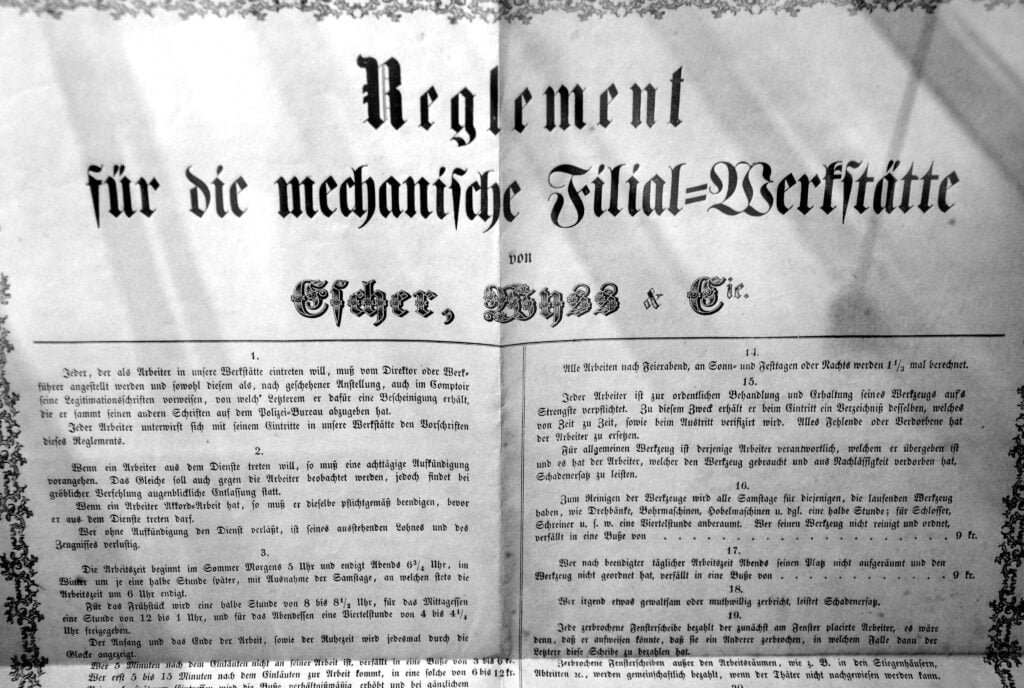
At the turn of the new century, Escher-Wyss had put the ribbon weaving to one side and begun to concentrate on much bigger projects similar the production of large industrial turbines and, in 1907, they sought an "approval and concession procedure" for the construction of a hydropower plant near Dogern am Rhein, which was reported in a Basel brochure from 1925.
By 1920, Escher-Wyss plant themselves embroiled in serious fiscal difficulties. The treaty of Versailles had restricted the military and economic growth of Frg post-obit the Great State of war, and the Swiss Visitor constitute the downturn in neighbouring national ceremonious applied science projects too much to bear. The parent co-operative of Escher-Wyss was located in Zurich and dated dorsum to 1805 and the visitor, which nonetheless benefited from a good reputation and a history lasting more than than a century, was deemed besides important to lose. In December 1920, a reorganization was carried out by writing down the share majuscule from 11.5 to 4.015 one thousand thousand French Francs and which was afterwards increased again to 5.515 million Swiss Francs. By the end of the financial twelvemonth of 1931, Escher-Wyss was still losing coin.
Still, the plucky company continued to deliver large scale ceremonious engineering science contracts throughout the 1920s as noted in the official correspondence written in 1924 from Wilhelm III Prince of Urach to the company Escher-Wyss and to the nugget manager of the Firm of Urach, auditor Julius Heller. This document discusses the "General Terms and Conditions of the Association of German Water Turbine Manufacturers for the Delivery of Machines and Other Equipment for Hydropower Plants". This is also confirmed in a brochure on the "Weather condition of the Association of High german Water Turbine Manufacturers for the Installation of Turbines and Motorcar Parts within the German Reich", printed on March 20, 1923 in an advertising brochure from Escher-Wyss for a universal oil pressure regulator.
Afterward the Smashing Depression in the early 1930s had laid waste to the global economy, Escher-Wyss announced, "as the catastrophic evolution of the economic situation in connection with the currency declines; The company [Escher-Wyss] is temporarily unable to go on its electric current liabilities in various customer countries." The company as well revealed that they would apply for a courtroom deferral to the Swiss newspaper Neue Zürcher Nachrichten, which reported on 1 December 1931 that, "the company Escher-Wyss has been granted a stay of defalcation until the end of March 1932 and, acting as curator in Switzerland, a trust company has been appointed." The article stated optimistically that, "at that place should exist a prospect of continuing operations." In 1931, Escher-Wyss employed around 1,300 non-contracted workers and 550 salaried employees.
By the mid-1930s, Escher-Wyss had once again constitute itself in financial trouble. In order to rescue the visitor this time, a consortium was brought on lath to save the ailing engineering business firm. The consortium was partly formed by the Federal Bank of Switzerland (which was coincidently headed past a Max Schwab, who is of no relation to Klaus Schwab) and further restructuring took place. In 1938, it was announced that an engineer at the firm, Colonel Jacob Schmidheiny would get the new President of the Board of Directors at Escher-Wyss. Presently subsequently the outbreak of war in 1939, Schmidheiny was quoted every bit saying, "The outbreak of war does not necessarily mean unemployment for the car industry in a neutral country, on the opposite." Escher-Wyss, and its new management, were apparently looking forward to profiting off the war, paving the mode for their transformation into a major Nazi military contractor.
A Brief History of Jewish Persecution in Ravensburg
When Adolf Hitler came to power, many things changed in Frg, and the story of the Jewish population of Ravensburg during that era is a sad one to tell. Even so, it was hardly the first fourth dimension that anti-Semitism had get-go been recorded as having reared its ugly head in the region.
In the Middle Ages, a synagogue, mentioned as far back equally 1345 was located at the centre of Ravensburg, serving a small Jewish customs which can exist traced from 1330 to 1429. At the end of 1429 and through 1430, the Jews of Ravensburg were targeted and a horrific massacre ensued. In the nearby settlements of Lindau, Überlingen, Buchhorn (later renamed Friedrichshafen), Meersburg and Konstanz, at that place were mass arrests of Jewish residents. The Jews of Lindau were burnt live during the 1429/1430 Ravensburg blood libel, in which members of the Jewish customs were accused of ritually sacrificing babies. In August 1430, in Überlingen, the Jewish community was forced to catechumen, 11 of them did so and the 12 who refused were killed. The massacres which took place in Lindau, Überlingen and Ravensburg happened with the direct approval of the ruling King Sigmund and any remaining Jews were soon expelled from the region.
Ravensburg had this ban confirmed by Emperor Ferdinand I in 1559 and it was upheld, for example, in an 1804 pedagogy issued for the city guard, which read: "Since the Jews are non allowed to engage in any trade or business organisation here, no one else is allowed to enter the city past mail or by wagon, The residual, however, if they take not received a let for a longer or shorter stay from the police role, are to be removed from the city by the police station."
Not until the 19th century were Jews able to settle legally in Ravensburg once again and, even past and so, their number remained so small that a synagogue was not rebuilt. In 1858, there were only 3 Jews recorded in Ravensburg and, in 1895, this number peaked at 57. From the plow of the century until 1933, the numbers of Jews living in Ravensburg had steadily decreased until the community was just made up of 23 people.
By the start of the 1930s, there were seven main Jewish families living in Ravensburg, including the Adler, Erlanger, Harburger, Herrmann, Landauer, Rose and Sondermann families. After the National Socialists seized power, some of the Ravensburg Jews were initially forced to emigrate, while others would later be murdered in Nazi concentration camps. Leading upwards to World War Two, there were many public displays of hatred towards the modest community of Jews in and around Ravensburg.
As early as March 13, 1933, about three weeks before the nationwide Nazi cold-shoulder of all Jewish shops in Frg, SA guards posted themselves in front of two of the five Jewish shops in Ravensburg and tried to prevent potential buyers from entering, putting upward signs on one shop stating "Wohlwert closed until Aryanization". Wohlwert's would soon go "Aryanised" and would exist the only Jewish-endemic shop to survive the Nazi pogrom. The other owners of the four big Jewish department stores in Ravensburg; Knopf; Merkur; Landauer and Wallersteiner were all forced to sell their properties to non-Jewish merchants between 1935 and 1938. During this period, many of the Ravensburg Jews were able to flee abroad earlier the worst of the National Socialist persecution began. While at least eight died violently, information technology was reported that three Jewish citizens who lived in Ravensburg survived because of their "Aryan" spouses. Some of the Jews who were arrested in Ravensburg during Kristallnacht were forced to march through the streets of Baden-Baden nether SS guard supervision the post-obit mean solar day and were after deported to Sachsenhausen concentration campsite.
Horrific Nazi crimes against humanity took place in Ravensburg. On 1 January 1934, the "Law for the Prevention of Hereditary Diseases" came into forcefulness in Nazi Deutschland, meaning people with diagnosed illnesses such every bit dementia, schizophrenia, epilepsy, hereditary deafness, and various other mental disorders, could be legally forcibly sterilised. In the Ravensburg City Hospital, today called Heilig-Geist Hospital, forced sterilisations were carried out beginning in Apr 1934. Past 1936, sterilisation was the most performed medical procedure in the municipal infirmary.
In the pre-war years of the 1930s leading up to the High german annexation of Poland, Ravensburg's Escher-Wyss manufactory, at present managed direct by Klaus Schwab's father, Eugen Schwab, continued to exist the biggest employer in Ravensburg. Not only was the factory a major employer in the town, but Hitler'due south own Nazi political party awarded the Escher-Wyss Ravensburg branch the title of "National Socialist Model Company" while Schwab was at the helm. The Nazis were potentially wooing the Swiss company for cooperation in the coming state of war, and their advances were eventually reciprocated.
Escher-Wyss Ravensburg and the War
Ravensburg was an anomaly in wartime Germany, every bit information technology was never targeted by any Centrolineal airstrikes. The presence of the Cerise Cantankerous, and a rumoured agreement with diverse companies including Escher-Wyss, saw the allied forces publicly agree to non target the Southern High german town. Information technology was not classified as a significant armed services target throughout the war and, for that reason, the town still maintains many of its original features. However, much darker things were afoot in Ravensburg once the war began.
Eugen Schwab continued to manage the "National Socialist Model Company" for Escher-Wyss, and the Swiss company would aid the Nazi Wermacht produce significant weapons of war likewise as more basic armaments. The Escher-Wyss company was a leader in big turbine technology for hydroelectric dams and power plants, just they likewise manufactured parts for German fighter planes. They were also intimately involved in much more sinister projects happening behind the scenes which, if completed, could have inverse the outcome of Earth State of war II.
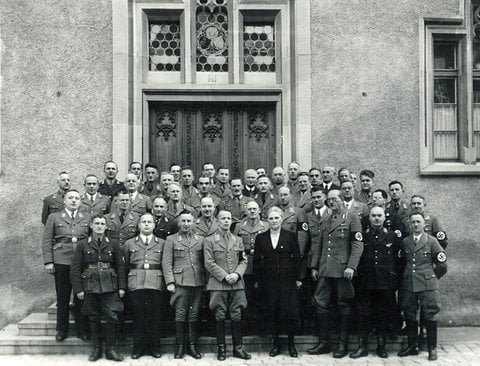
Western military machine intelligence were already aware of Escher-Wyss' complicity and collaboration with the Nazis. At that place are records available from western military intelligence at the time, specifically Record Group 226 (RG 226) from the information compiled past the Office of Strategic Services (OSS), which shows the Allied forces were aware of some of the Escher-Wyss' business dealings with the Nazis.
Inside RG 226, at that place are 3 specific mentions of Escher-Wyss including:
- File number 47178 which reads: Escher-Wyss of Switzerland is working on a large order for Germany. Flame-throwers are despatched from Switzerland under the name Brennstoffbehaelter. Dated Sept. 1944.
- File number 41589 showed that the Swiss were allowing German language exports to exist stored in their country, a supposedly neutral nation during Globe War II. The entry reads: Business relations between Empresa Nacional Calvo Sotelo (ENCASO), Escher Wyss, and Mineral Celbau Gesellschaft. i p. July 1944; meet besides 50 42627 Written report on collaboration between the Spanish Empresa Nacional Calvo Sotelo and the German language Rheinmetall Borsig, on High german exports stored in Switzerland. 1 p. August 1944.
- File number 72654 claimed that: Hungary'southward bauxite was formerly sent to Germany and Switzerland for refining. Then a regime syndicate built an aluminium institute at Dunaalmas on the borders of Hungary. Electric power was provided; Hungary contributed coal mines, and equipment was ordered from the Swiss business firm Escher-Wyss. Production began in 1941. ii pp. May 1944.
Notwithstanding, Escher-Wyss were leaders in one blossoming field in particular, the creation of new turbine technology. The company had engineered a fourteen,500 HP turbine for the Norsk Hydro industrial facility'due south strategically important hydroelectric plant at Vemork, near Rjukan in Norway. The Norsk Hydro plant, part powered by Escher Wyss, was the only industrial found under Nazi control capable of producing heavy h2o, an ingredient essential for making plutonium for the Nazi atomic bomb plan. The Germans had put all possible resources behind the production of heavy water, just the Allied forces were aware of the potentially game-changing tech advances by the increasingly drastic Nazis.
During 1942 and 1943, the hydro plant was the target of partially successful British Commando and Norwegian Resistance raids, although heavy h2o product continued. The Centrolineal forces would drop more 400 bombs on the plant, which barely affected the operations at the sprawling facility. In 1944, High german ships attempted to send heavy h2o back to Deutschland, but the Norwegian Resistance were able to sink the ship carrying the payload. With assist from Escher-Wyss, the Nazis were almost able to change the tides of war and bring about an Axis victory.
Back in the Escher-Wyss factory in Ravensburg, Eugen Schwab had been busy putting forced labourers to piece of work at his model Nazi company. During the years of World War II, nearly 3,600 forced labourers worked in Ravensburg, including at Escher Wyss. According to the city archivist in Ravensburg, Andrea Schmuder, the Escher-Wyss automobile manufacturing plant in Ravensburg employed between 198 and 203 civil workers and POWs during the state of war. Karl Schweizer, a local Lindau historian, states that Escher-Wyss maintained a small special camp for forced labourers on the manufacturing plant bounds.
The utilise of masses of forced labourers in Ravensburg fabricated information technology necessary to setup one of the largest recorded Nazi forced labour camps in the workshop of a quondam carpenter's at Ziegelstrasse sixteen. At one time, the military camp in question accommodated 125 French prisoners of state of war who were subsequently redistributed to other camps in 1942. The French workers were replaced by 150 Russian prisoners of war who, it was rumoured, were treated the worst out of all the POWs. One such prisoner was Zina Jakuschewa, whose work card and work book are held by the United States Holocaust Memorial Museum. Those documents identify her equally a not-Jewish forced labourer assigned to Ravensburg, Federal republic of germany, during 1943 and 1944.
Eugen Schwab would dutifully maintain the status quo during the war years. After all, with young Klaus Martin Schwab having been born in 1938 and his brother Urs Reiner Schwab born a few years later, Eugen would have wanted to keep his children out of harm's way.
Klaus Martin Schwab – International Man of Mystery
Born on 30 March 1938 in Ravensburg, Deutschland, Klaus Schwab was the eldest child in a normal nuclear family. Between 1945 and 1947, Klaus attended chief school in Au, Deutschland. Klaus Schwab recalls in a 2006 interview with the Irish gaelic Times that:"After the war, I chaired the Franco-German regional youth association. My heroes were Adenauer, De Gasperi and De Gaulle."
Klaus Schwab and his younger brother, Urs Reiner Schwab, were both to follow in the footsteps of their granddad, Gottfried, and their father, Eugen, and would both initially train as car engineers. Klaus'southward father had told the immature Schwab that, if he wanted to make an bear upon on the world, and then he should railroad train every bit a Car Engineer. This would only exist the outset of Schwab's Academy credentials.
Klaus would begin studying his plethora of degrees at Spohn-Gymnasium Ravensburg between 1949 and 1957, eventually graduating from the Humanistisches Gymnasium in Ravensburg. Between 1958 and 1962, Klaus began working with various applied science companies and, in 1962, Klaus completed his mechanical engineering studies at the Swiss Federal Constitute of Applied science (ETH) in Zurich with an engineering diploma. The following year, he as well completed an economics course at the University of Fribourg, Switzerland. From 1963 until 1966, Klaus worked as Banana to the Manager-General of the German Motorcar-building Association (VDMA), Frankfurt.
In 1965, Klaus was likewise working on his doctorate from the ETH Zurich, writing his dissertation on: "The longer-term export credit as a business problem in mechanical engineering". And then, in 1966, he received his Doctorate in Technology from the Swiss Federal Institute of Technology (ETH), Zurich. At this time, Klaus's father, Eugen Schwab, was swimming in bigger circles than he had previously swam. After being a well known personality in Ravensburg every bit the Managing Managing director of the Escher-Wyss factory from earlier the war, Eugen would eventually be elected every bit President of the Ravensburg Chamber of Commerce. In 1966, during the founding of the High german committee for Splügen railway tunnel, Eugen Schwab divers the founding of the German committee equally a project "that creates a better and faster connection for large circles in our increasingly converging Europe and thus offers new opportunities for cultural, economic and social evolution".
In 1967, Klaus Schwab gained a Doctorate in Economics from the University of Fribourg, Switzerland every bit well as a Principal of Public Administration qualification from the John F. Kennedy Schoolhouse of Regime at Harvard in the United States. While at Harvard, Schwab was taught past Henry Kissinger, who he would afterward say were among the height 3-4 figures who had nearly influenced his thinking over the course of his entire life.

In the previously mentioned Irish Times commodity of 2006, Klaus talks about that period every bit being very important to the formation of his nowadays idealogical thinking, stating: "Years later, when I came dorsum from the US afterward my studies at Harvard, there were two events that had a decisive triggering effect on me. The first was a book past Jean-Jacques Servan-Schreiber, The American Claiming – which said Europe would lose out against the US considering of Europe's inferior direction methods. The other issue was – and this is relevant to Ireland – the Europe of the six became the Europe of the nine." These two events would help shape Klaus Schwab into a human being who wanted to change the style people went nearly their business organisation.
That same year, Klaus'due south younger brother Urs Reiner Schwab graduated from ETH Zurich as a mechanical engineer, and Klaus Schwab went to work for his begetter'southward old company, Escher-Wyss, soon to become Sulzer Escher-Wyss AG, Zurich, every bit Assistant to the Chairman to help in the reorganisation of the merging companies. This leads u.s. towards Klaus's nuclear connections.
The ascension of a technocrat
Sulzer, a Swiss company whose origins appointment back to 1834, had outset risen to prominence after starting to build compressors in 1906. Past 1914, the family-run house had become role of "three joint-stock companies," one of which was the official holding company. In the 1930s, Sulzer'south profits would suffer during the Not bad Depression and, like many businesses at the fourth dimension, faced disruption and industrial deportment from their workers.
World State of war II may non have afflicted Switzerland as much as her neighbours, merely the economical nail that was to follow led to Sulzer growing in power and market place dominance. In 1966, merely before the arrival of Klaus Schwab at Escher-Wyss, the Swiss turbine manufacturers signed a cooperation agreement with the Sulzer brothers in Winterthur. Sulzer and Escher-Wyss would begin to merge in 1966, when Sulzer purchased 53% of the company shares. Escher-Wyss would officially become Sulzer Escher-Wyss AG in 1969 when the last of the shares were acquired by the Sulzer brothers.
Once the merger had started, Escher-Wyss would begin to be restructured and two of the existing Board Members would be the showtime to discover their service to Escher-Wyss coming to an end. Dr. H. Schindler and Due west. Stoffel would resign from the Board of Directors now headed by Georg Sulzer and Alfred Schaffner. Dr. Schindler had been a member of the Escher-Wyss Board of Directors for 28 years and had worked alongside Eugen Schwab throughout much of his service. Peter Schmidheiny would later accept over as Chairman of the Board of Directors of Escher-Wyss, continuing the Schmidheiny family rule over the company's executives.
During the restructuring process, information technology was decided that Escher-Wyss and Sulzer would concentrate on separate areas of motorcar engineering with the Escher-Wyss factories primarily piece of work on hydraulic ability constitute construction, including turbines, storage pumps, reversing machines, closing devices and pipelines, as well as steam turbines, turbo compressors, evaporation systems, centrifuges and machines for the paper and pulp industry. Sulzer would concentrate on the refrigeration manufacture as well as steam boiler construction and gas turbines.
On 1 January 1968, the freshly reorganised Sulzer Escher-Wyss AG was rolled out publicly and the company had become streamlined, a movement deemed necessary because of several big acquisitions. This included a close collaboration with Chocolate-brown Boveri, a grouping of Swiss electric engineering companies who had also worked for the Nazis, supplying the Germans with some of their U-boat technology used during World War Two. Dark-brown Boveri was also described every bit "defence force-related electrical contractors" and would find the conditions of the Cold War artillery race to be benign to their business.
The merger and reorganisation of these Swiss mechanical engineering giants saw their collaboration pay off in unique ways. During the 1968 Wintertime Olympics in Grenoble, Sulzer and Escher-Wyss used viii refrigeration compressors to create tonnes of artificial ice. In 1969, the two firms combined to assist in the building of a new passenger ship named "Hamburg", the first transport in the world to be fully air-conditioned thank you to the Sulzer Escher-Wyss combination.
In 1967, Klaus Schwab officially burst onto the scene of the Swiss business community and took a lead in the merger between Sulzer and Escher-Wyss, as well as forming profitable alliances with Chocolate-brown Boveri and others. In December 1967, Klaus would speak at a Zurich event to the top Swiss machine engineering organisations; the Employers Association of Swiss Machine and Metal Manufacturers and the Association of Swiss Machine Manufacturers.
In his talk, he would correctly predict the importance of incorporating computers into modern Swiss machine applied science, stating that:
"In 1971, products that are not even on the market today are likely to business relationship for up to a quarter of sales. This requires companies to systematically research possible developments and place gaps in the market. Today, 18 of the xx largest companies in our machine industry have planning departments that are entrusted with such tasks. Of course, everyone has to make use of the latest technological advances, and the computer is one of them. The many pocket-sized and medium-sized companies in our motorcar industry take the path of cooperation or utilize the services of special information processing service providers."
Computers and data were obviously seen equally important to the hereafter, according to Schwab, and this was further projected in the reorganisation of Sulzer Escher-Wyss during their merger. Sulzer's mod website reflects this noteworthy change in direction, stating that, in 1968: "Cloth technology activities are intensified [by Sulzer] and course the basis for medical engineering science products. The fundamental change from a auto-building company to a engineering corporation starts to become apparent."
Klaus Schwab was helping to turn Sulzer Escher-Wyss into something more than but a machine building giant, he was transforming them into a technology corporation driving at high speed into a hello-tech future. It should also be noted that Sulzer Escher-Wyss changed another focus of their business organisation to help them "class the ground for medical applied science products," an area non previously mentioned as a target industry for Sulzer and/or Escher-Wyss.
Just technological advancement wasn't the simply upgrade Klaus Schwab wanted to introduce at Sulzer Escher-Wyss, he also wanted to modify how the company thought about their business managerial style. Schwab and his shut associates were pushing an entirely new business philosophy which would permit "all employees to accept the imperatives of motivation and to ensure at dwelling house a sense of flexibility and manoeuvrability."
It is here in the late 1960s where we see Klaus begin to emerge as a more public figure. At this fourth dimension, the Sulzer Escher-Wyss visitor as well became more interested in engaging with the press than ever before. In January 1969, the Swiss giants setup a public advisory session entitled the "Press Day of the Machine Industry", which mainly concerned questions on company direction. During the event, Schwab would state that companies using authoritarian styles of business management are "unable to fully activate the 'man capital letter'", an argument he would utilize on many carve up occasions during the tardily 1960s.
Plutonium and Pretoria
Escher-Wyss were pioneers in some of the about important tech in power generation. As the US Department of Free energy points out in their paper on Supercritical CO2 Brayton Cycle Development (CBC), a device used in hydro and nuclear ability plants, "Escher-Wyss was the start company known to develop the turbomachinery for CBC systems starting in 1939." Going on to state that 24 systems were congenital, "with Escher-Wyss designing the power conversion cycles and edifice the turbomachinery for all but 3". Past 1966, just before the entrance of Schwab into Escher-Wyss and the start of the Sulzer merger, the Escher-Wyss helium compressor was designed for the La Fleur Corporation and continued the evolution of the Brayton Bike Development. This technology was withal of importance to the arms industry by 1986, with nuclear powered drones being equipped with a helium-cooled Brayton bicycle nuclear reactor.
Escher-Wyss had been involved with manufacturing and installing nuclear technology at least as early as 1962, every bit shown by this patent for a "heat substitution arrangement for a nuclear power constitute" and this patent from 1966 for a "nuclear reactor gas-turbine plant with emergency cooling". Afterwards Schwab left Sulzer Escher-Wyss, Sulzer would besides help to develop special turbocompressors for uranium enrichment to yield reactor fuels.
When Klaus Schwab joined Sulzer Escher-Wyss in 1967 and started the reorganisation of the company to be a technology corporation, the involvement of Sulzer Escher-Wyss in the darker aspects of the global nuclear arms race became immediately more pronounced. Before Klaus became involved, Escher-Wyss had often concentrated on helping design and build parts for civilian uses of nuclear technology, due east.g. nuclear ability generation. Yet, with the arrival of the eager Mr. Schwab also came the company's participation in the illegal proliferation of nuclear weapons engineering science. By 1969, the incorporation of Escher Wyss into Sulzer was fully completed and they would exist rebranded into Sulzer AG, dropping the historic proper name Escher-Wyss from their proper name.
It was eventually revealed, thank you to a review and written report carried out by the Swiss authorities and a human being named Peter Hug, that Sulzer Escher-Wyss began secretly procuring and building fundamental parts for nuclear weapons during the 1960s. The company, while Schwab was on the lath, as well began playing a critical key role in the evolution of South Africa's illegal nuclear weapons plan during the darkest years of the apartheid regime. Klaus Schwab was a leading figure in the founding of a company culture which helped Pretoria build six nuclear weapons and partially gather a 7th.
In the report, Peter Hug outlined how Sulzer Escher Wyss AG (referred to post-merger every bit just Sulzer AG) had supplied vital components to the South African government and establish evidence of Germany's role in supporting the racist regime, likewise revealing that the Swiss government "was aware of illegal deals only 'tolerated them in silence' while supporting some of them actively or criticised them only half-heartedly". Hug's report was eventually finalised in a piece of work entitled: "Switzerland and South Africa 1948-1994 – Final Report of the NFP 42+ commissioned by the Swiss Federal Council" which was compiled and written by Georg Kreis and published in 2007.
By 1967, South Africa had synthetic a reactor as part of a plan to produce plutonium, the SAFARI-2 located at Pelindaba. SAFARI-2 was role of a project to develop a reactor moderated by heavy water which would be fuelled by natural uranium and cooled using sodium. This link to developing heavy water for the creation of uranium, the same technology which had been utilised by the Nazis also with the help of Escher-Wyss, may explain why S Africans initially got Escher-Wyss involved. Simply past 1969, South Africa abased the heavy water reactor project at Pelindaba considering it was draining resource from their uranium enrichment plan that had outset begun in 1967.
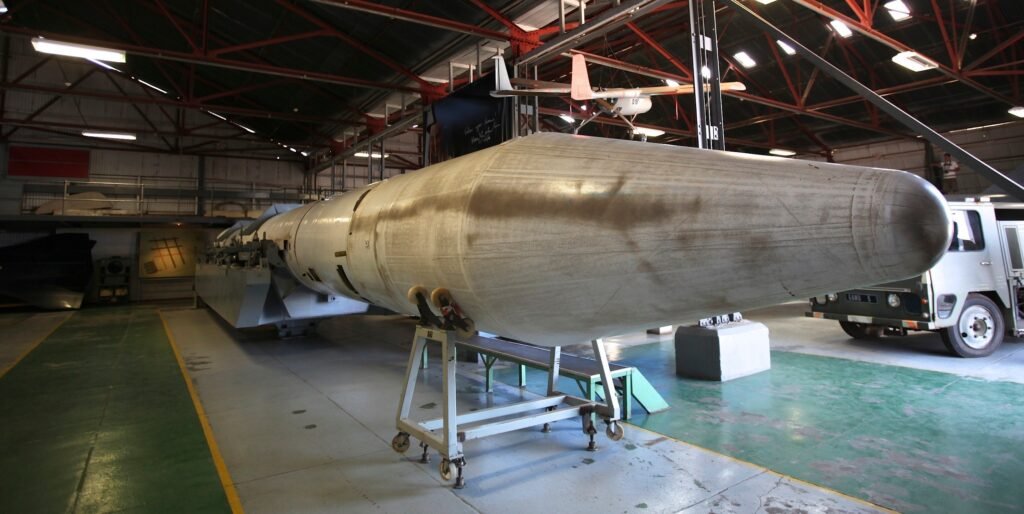
In 1970, Escher-Wyss were definitely deeply involved with nuclear technology, as seen in a tape available in the Landesarchivs Baden-Württemberg. The record shows details of a public procurement process and contains data about award talks with specific companies involved in the procurement of nuclear technology and materials. The companies cited include: NUKEM; Uhde; Krantz; Preussag; Escher-Wyss; Siemens; Rheintal; Leybold; Lurgi; and the infamous Transnuklear.
The Swiss and S Africans had a close relationship through this period of history, when it was inappreciably like shooting fish in a barrel for the roughshod South African regime to find close allies. By four Nov 1977, the United nations Security Council had enacted resolution 418 which imposed a mandatory arms embargo against Southward Africa, an embargo that wouldn't be fully lifted until 1994.
Georg Kreis pointed out the following in his detailed assessment of the Hug study:
"The fact that the authorities assumed a laisse-faire attitude even after May 1978 comes to the fore in an commutation of letters betwixt the Anti-Apartheid Movement and the DFMA in Oct/Dec 1978. As the study by Hug explicates, the Anti-Apartheid Movement of Switzerland pointed to German reports according to which Sulzer Escher-Wyss and a visitor called BBC had supplied parts for the South African uranium enrichment plant, and to repeated credits to ESCOM, which also included considerable contributions by Swiss banks. These assertions led to questions of whether the Federal Council – in light of fundamental support of the UN embargo, ought non to instigate the National Bank to stop authorising credits for ESCOM in the future."
Swiss banks would help to fund the South African race to nukes and, by 1986, Sulzer Escher-Wyss were successfully producing special compressors for uranium enrichment.
The Founding of the Earth Economic Forum
In 1970, the young upstart, Klaus Schwab wrote to the European Commission and asked for help in setting upward a "non-commercial remember tank for European business leaders". The European Commission would sponsor the event as well, sending French politico Raymond Barre to act as the forum's "intellectual mentor". Raymond Barre, who was at that time European Commissioner for Economic and Financial Diplomacy, would later become on to become French PM and would be accused of making anti-Semitic comments while in role.
So, in 1970, Schwab left Escher Wyss to organise a 2-calendar week business organisation managerial conference. In 1971, the first meeting of the World Economical Forum – and so called the European Management Symposium – convened in Davos, Switzerland. Around 450 participants from 31 countries would accept function in Schwab's offset European Management Symposium, mostly made upwardly of managers from various European companies, politicians, and The states academics. The project was recorded as organised by Klaus Schwab and his secretary Hilde Stoll who, later the same twelvemonth, would become Klaus Schwab's wife.
Klaus's European symposium was not an original idea. As author Ganga Jey Aratnam stated quite coherently in 2018:
"Klaus Schwab'due south "Spirit of Davos" was also the "Spirit of Harvard". Not but had the business school advocated the idea of a symposium. Prominent Harvard economist John Kenneth Galbraith championed the affluent gild as well as capitalism's planning needs and the rapprochement of East and Westward."
It was too truthful that, as Aratnam too pointed out, this was non the first fourth dimension Davos had hosted such events. Between 1928 and 1931, the Davos University Conferences took place at the Hotel Belvédère, events which were co-founded by Albert Einstein and were but halted past the Swell Depression and the threat of looming war.
The Gild of Rome and the WEF
The nigh influential group that spurred the creation of Klaus Schwab's symposium was the Club of Rome, an influential think tank of the scientific and monied aristocracy that mirrors the Earth Economic Forum in many ways, including in its promotion of a global governance model led by a technocratic aristocracy. The Order had been founded in 1968 past Italian industrialist Aurelio Peccei and Scottish chemist Alexander Male monarch during a private meeting at a residence owned past the Rockefeller family in Bellagio, Italy.
Amidst its starting time accomplishments was a 1972 book entitled "The Limits to Growth" that largely focused on global overpopulation, alert that "if the world's consumption patterns and population growth continued at the aforementioned high rates of the time, the earth would strike its limits within a century." At the tertiary meeting of the World Economic Forum in 1973, Peccei delivered a speech summarizing the book, which the World Economical Forum website remembers as having been the distinguishing event of this historical meeting. That same yr, the Club of Rome would publish a report detailing an "adaptive" model for global governance that would split up the earth into x, inter-connected economical/political regions.
The Club of Rome was long controversial for its obsession with reducing the global population and many of its earlier policies, which critics described every bit influenced by eugenics and neo-Malthusian. Withal, in the Club'due south infamous 1991 Book, The Starting time Global Revolution, it was argued that such policies could proceeds popular support if the masses were able to link them with an existential fight against a common enemy.
To that effect, The First Global Revolution contains a passage entitled "The mutual enemy of humanity is Man", which states the following:
"In searching for a mutual enemy confronting whom nosotros can unite, we came up with the idea that pollution, the threat of global warming, h2o shortages, famine and the similar, would fit the bill. In their totality and their interactions these phenomena practise constitute a common threat which must be confronted by everyone together. But in designating these dangers equally the enemy, we autumn into the trap, which we have already warned readers about, namely mistaking symptoms for causes. All these dangers are caused by human intervention in natural processes, and it is only through changed attitudes and behaviour that they tin be overcome. The real enemy then is humanity itself."
In the years since, the elite that populate the Social club of Rome and the Globe Economic Forum have frequently argued that population control methods are essential to protecting the environs. It is thus unsurprising that the World Economical Forum would similarly use the issues of climate and environment as a way to market place otherwise unpopular policies, such every bit those of the Great Reset, as necessary.
The Past is Prologue
Since the founding of the World Economic Forum, Klaus Schwab has become ane of the well-nigh powerful people in the earth and his Smashing Reset has fabricated information technology more than important than always to scrutinize the homo sitting on the globalist throne.
Given his prominent part in the far-reaching effort to transform every aspect of the existing gild, Klaus Schwab's history was difficult to research. When you start to dig into the history of a human being similar Schwab, who sits aloft other shadowy elite movers and shakers, yous soon find lots of data has been hidden or removed. Klaus is somebody who wants to stay hidden in the shadowy corners of club and who will simply allow the boilerplate person to see a well-presented construct of their chosen persona.
Is the real Klaus Schwab a kindly quondam uncle figure wishing to do adept for humanity, or is he really the son of a Nazi collaborator who used slave labour and helped the Nazi efforts to obtain the first atomic bomb? Is Klaus the honest business director who we should trust to create a fairer society and workplace for the common homo, or is he the person who helped push Sulzer Escher-Wyss into a technological revolution that led to its role in the illegal creation of nuclear weapons for Southward Africa's racist apartheid authorities? The evidence I have looked at does not suggest a kindly man, but rather a member of a wealthy, well-connected family that has a history of helping create weapons of mass devastation for aggressive, racist governments.
As Klaus Schwab said in 2006 "Knowledge will soon exist available everywhere – I telephone call it the 'googlisation' of globalisation. It'south not what you lot know any more, it'due south how you use information technology. You have to be a pace setter." Klaus Schwab considers himself to be a pace setter and a height tabular array actor, and information technology must exist said that his qualifications and experience are impressive. Notwithstanding, when it comes to practising what you preach, Klaus has been constitute out. Ane of the iii biggest challenges on the priority list for the World Economic Forum is the non-proliferation of nuclear weapons, yet neither Klaus Schwab nor his father Eugen lived up to those same principles when they were in business organisation. Quite the opposite.
In January, Klaus Schwab announced that 2021 is the year that the Earth Economic Forum and its allies must "rebuild trust" with the masses. However, if Schwab continues to hide his history and that of his father'southward connections to the "National Socialist Model Company" that was Escher-Wyss during the 1930s and 1940s, then people will accept good reason to distrust the underlying motivations of his overreaching, undemocratic Great Reset agenda.
In the example of the Schwabs, the evidence doesn't signal at simply poor business practices or some sort of misunderstanding. The story of the Schwab family instead reveals a habit of working with genocidal dictators for the base motives of turn a profit and power. The Nazis and the Southward African apartheid regime are ii of the worst examples of leadership in mod politics, still the Schwabs obviously couldn't or wouldn't come across that at the fourth dimension.
In the case of Klaus Schwab himself, it appears that he has helped to wash relics of the Nazi era, i.due east. its nuclear ambitions and its population control ambitions, so as to ensure the continuity of a deeper calendar. While serving in a leadership capacity at Sulzer Escher Wyss, the company sought to aid the nuclear ambitions of the Due south African regime, then the near Nazi adjacent government in the world, preserving Escher Wyss' own Nazi era legacy. Then, through the World Economical Forum, Schwab has helped to rehabilitate eugenics-influenced population control policies during the post-World State of war Two era, a time when the revelations of Nazi atrocities chop-chop brought the pseudo-science into great disrepute. Is in that location whatsoever reason to believe that Klaus Schwab, as he exists today, has changed in anyway? Or is he nonetheless the public face of a decades-long effort to ensure the survival of a very old calendar?
The final question that should exist asked about the real motivations backside the actions of Herr Schwab, may exist the most of import for the time to come of humanity: Is Klaus Schwab trying to create the Fourth Industrial Revolution, or is he trying to create the 4th Reich?
Source: https://unlimitedhangout.com/2021/02/investigative-reports/schwab-family-values/

Post a Comment for "81-year-old Franklin Township Man Alleges He Was Confronted About the Red Make America Great Again"