The Avantgarde Icon Russian Avantgarde Art and the Icon Painting Tradition
The avant-garde was banned in the USSR for over v decades. Betwixt 1932 and the end of the 1980s, Soviet artists were compelled to abandon any creative experimentation. The piece of work they had once washed, held in museums throughout the state, was hidden away and sometimes destroyed. Yet at this time, George Costakis (Moscow 1913 – Athens 1990) congenital up a unique collection of avant-garde art dating from the 1910s and 1920s, which he preserved alongside the antique Russian and post-Byzantine paintings he had also assembled.
Today, information technology is widely acknowledged that the Russian advanced fabricated a substantial contribution to uncovering the artful pregnant of early Russian icons. Academic studies analysing the icon as a source for the Russian avant-garde are extensively available. In this context, the historiography of Costakis's collection is of meaning historical and cultural interest.
In the 1960s and 1970s, the collector's flat in Moscow (which consisted of eleven or twelve rooms) was considered past many as a project for a 'museum of the Russian advanced'. Alongside experimental objects d'art, it displayed traditional Russian icons and a collection of folk toys, while besides offering a substantial library and archive. The numerous distinguished cultural and political figures who came to see the exhibits included Edward Kennedy, David Rockefeller, Michelangelo Antonioni, Marc Chagall and Igor Stravinsky. But it was not until 2014 that a sizeable office of the collection was shown to the wider public at an exhibition organized by the Tretyakov Gallery in Moscow, commemorating the 100th anniversary of Costakis'southward nascency.ane
Symbols and connections
Overall, the collection was by no means exceptional, fifty-fifty for its time. The items on display did not behave comparing with the pre-revolutionary collections of Ilya Ostroukhov and Stepan Ryabushinsky, for case. All the same, for the first fourth dimension, Costakis' collection drew articulate links between religious iconography and the paintings of early on twentieth-century Russian avant-garde artists. Costakis introduced the Russian advanced to the Due west, while as well making an important contribution to the study of connections between the icon and avant-garde fine art generally. He demonstrated how folk fine art and iconography could raise the understanding of specific features of the Russian advanced in the context of twentieth-century modernism.

Costakis described the beginnings of his fascination with icons in the following way:
I started by collecting icons aslope advanced works. Initially I wasn't particularly interested in the icons. I didn't sympathize them and had no feeling for their qualities as works of art. In general, iconography failed to motility me. Simply avant-garde art opened my eyes to the pregnant of icons. I began to run into that the two were intimately related and profoundly interconnected. I came to recognize elements of abstract painting and suprematism, and all kinds of universal symbolism, in iconography … Over fourth dimension, I managed to assemble a large collection of icons – most a hundred and l painted panels dating from the fifteenth to the seventeenth centuries.2
Information technology is clear that Costakis saw icons as an integral role of his drove and, every bit the possessor of a substantial library and archive, he must have been familiar with bookish ideas well-nigh links between the icon and the avant-garde. He had been collecting literature and documents on the discipline since the early 1950s. His library included Alexey Grishchenko's book The Medieval Russian Icon as an Fine art of Painting (Moscow 1917), which described, in some detail, the Russian avant-garde'south preoccupation with the icon. The archive besides included Alexander Shevchenko's famous manifesto 'Neo-primitivism: Its Theory, its Possibilities, its Achievements' (1913), as well as the catalogue for the Exhibition of Icon Painters' Manuals and Popular Prints, a display organized in Moscow by Mikhail Larionov in 1913.
The sources Costakis trusted most, however, were the surviving representatives of the early on Russian avant-garde, who convinced him of the importance of links betwixt their work and iconography. In his memoirs, Costakis devotes special attention to his relationship with Marc Chagall, who had painted works influenced by icons and religious popular prints in the offset decade of the twentieth century and, later, completed a series of paintings on Biblical subjects. The two men are very likely to have discussed 'the icon and the avant-garde' and corresponded on the subject.
An indirect confirmation of this can be found in Costakis's business relationship of his relations with the French cultural attaché, Alexandre Kem, who passed on letters from Chagall to him from 1952. 'Nosotros spoke about Chagall's fine art,' Costakis writes, referring to a conversation with Kem. 'I drew parallels between the icon and his piece of work.' During his first visit to the West in 1956, Costakis was introduced – through Chagall – to Mikhail Larionov and Natalia Goncharova, in whose art the icon played a vital part.
He as well met Nina Kandinsky, who endemic Russian folk icons from the nineteenth century, previously belonging to Wassily Kandinsky and now held past the Kandinsky Fund at the Heart Pompidou in Paris. Several icons from this collection were first shown in 2011, at the 'Chagall and the Russian avant-garde' exhibition in Paris.
In Moscow, Costakis was in touch on with many icon collectors, scholars, writers and art historians. He was not alone in seeing the influence of iconography on the Russian avant-garde – the specialists who brash him on assembling his pieces were as aware of the link. The well-nigh important figures included Russian scholars Nikolai Khardzhiev and Dmitry Sarabyanov, as well as the Western fine art historian Alfred Barr.3 Nonetheless, the connections that had a special significance for Costakis were with artists themselves – especially representatives of the so-called 'second wave' of Russian avant-garde art in the 1960s and 1970s.
This group of artists saw icons as 'pure fine art', in exactly the way they had been interpreted by the early Russian avant-garde in the 1910s and 1920s. Pocket-size collections of icons, housed in the flats and studios of artists such as Dmitry Krasnopevtsev or Vasily Sitnikov, created the impression of a world apart, a gratuitous private infinite, independent of Soviet life with all its restrictions. While Krushchev or Brezhnev were in power, the beauty and reverse perspective of medieval icons seemed to counter the dogmatism and monotony of the Soviet system in the minds of people associated with unofficial creative circles. At the time, Costakis was also collecting paintings by artists of the second Russian advanced, including Dmitry Plavinsky, Dmitry Krasnopevtsev and Vladimir Nemukhin.
Liturgical art and folk primitivism
At the finish of the 1980s, as perestroika took concord in the USSR, the history of the Russian avant-garde ceased to be a banned topic. This was reflected in a serial of exhibitions on Kazimir Malevich, Wassily Kandinsky, Lyubov Popova and Pavel Filonov, as well as in the appearance of new research on the subject. The writing of Nikolai Khardzhiev, the leading specialist on the Russian advanced at the time, was particularly influential. In 1976, Khardzhiev had succeeded in publishing a collection of manufactures and documents entitled Towards a History of the Russian Advanced, which appeared in Stockholm. For the first time, his book offered an analysis of Kazimir Malevich's autobiographical comments on the icon and concluded that: 'At the end of 1912, Malevich completed a series of works, in which the traditions of early Russian art and folk primitivism intersect with "metallic" forms derived from Cubism'.
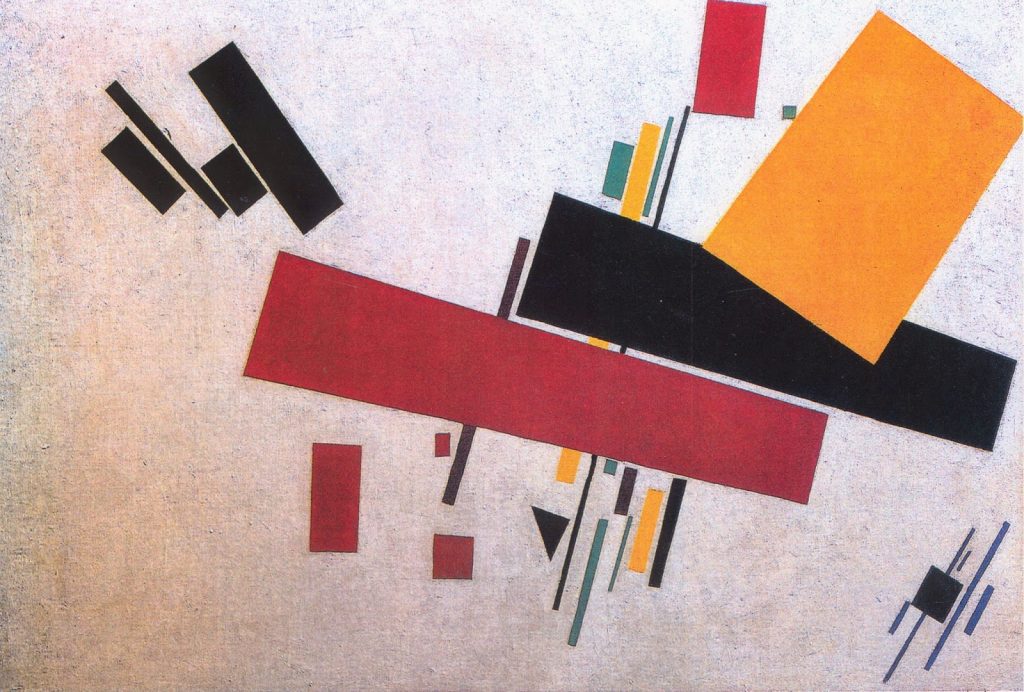
Dynamic Suprematism No 57 by Kazimir Malevich (1916). Photo by Arturo García from Flickr
A significant corporeality of material in Khardzhiev'southward personal annal also confirms the view that Russian Cubo-Futurism was influenced by iconography. Khardzhiev knew many avant-garde artists personally, and at the beginning of the 1930s, while working on his History of Russian Futurism, he asked Malevich to write a memoir for his archive. In his autobiographical notes, Malevich openly acknowledged the influence of the icon on his work: 'Icons made a strong impression on me, despite my naturalistic grooming and the way this defined my responses to the natural earth. For me, icons seemed to reveal the Russian people every bit an entity, a whole with an emotional creativity of its own.'four
In 1995, Khardzhiev gave an interview to the Russian journal Zerkalo, in which he emphasized once once again the significance of the icon for understanding the linguistic communication of the Russian avant-garde and its specifically national features:
The art of the advanced was international, but there was nevertheless a national accent. There was such a matter as Russian primitivism – and this is not widely acknowledged in the Westward. Take Larionov – his work is primitivist: consider a Russian popular print or an icon … The icon is unbelievably monumental. The Russians followed the Greek tradition, but they created their ain iconography … The icon and primitivism transformed western artistic influences, their effects confronted Cubism and, as a result, a new form of Russian art appeared – non imitative, but unique and original.five
Later, in his introductory article to the catalogue of the Malevich exhibition, shown in St. petersburg, Moscow, and Amsterdam in 1988-1989, Dmitry Sarabyanov wrote: 'To a sure extent, the Suprematist canvases Malevich created gravitated toward the icon. They "aspired to be" reflections on the nature of being, thoughts in "form and colour".'6
The perestroika years as well saw the appearance of an early article I wrote on this field of study, entitled 'The Icon in the Russian avant-garde of the 1910s and 1920s'.7 It was a short slice, simply the offset specialized publication to focus exclusively on the topic of 'the icon and the avant-garde'. The commodity was written in response to the interest in primitivist art and Russian popular consciousness prevalent at the fourth dimension. It offered an analysis of Malevich's autobiographical notes, and the way in which they revealed elements of iconographic language in paintings by Goncharova, Larionov and other artists.
Artistic devices from another age
Costakis' interpretation of the event of the icon on the avant-garde is also likely to accept been influenced past the American art historian Alfred Barr, who saw his drove during a visit to Moscow in 1956. Barr was the leading western specialist on the Russian avant-garde at the time and the erstwhile first director of the Museum of Modern Fine art in New York (MoMa).
Later on examining the items Costakis had assembled, Barr persuaded him to focus as much as possible on abstract painting. Following the come across, Costakis jettisoned the figurative works by representatives of the Jack of Diamonds movement, and began to collect abstract pieces by Alexander Rodchenko, Lyubov Popova, Vladimir Tatlin and other hitherto forgotten artists, likewise every bit early works by Malevich, Kandinsky and Chagall.
In the 1950s, abstract art had become increasingly fashionable in Europe and American Abstruse Expressionism was coming to boss the art market. Barr'due south favourite Russian painters were Malevich and Rodchenko. He had shown their work in his historic exhibition 'Cubism and Abstruse Art', held at MoMA in 1936. Certainly, Barr appreciated the possibility of links between icons and the avant-garde works in Costakis' collection, particularly the abstruse pieces. Barr had first visited Moscow in 1928 and he had seen Ilya Ostroukhov's individual Museum of Early Russian Painting (in existence from 1911 until 1928). His dear and admiration for the Russian icon cannot be in doubt.
On the ground of her detailed written report of Barr'south Moscow diaries, the American scholar Sybil Kantor remarks: 'One of the most important reasons for Barr's trip to Russia was his desire to written report medieval icons for his dissertation … In Barr's diary, there is almost as much written about icons as there is almost contemporary artworks.'
We also learn from Barr's diary that, in add-on to Malevich, Rodchenko and the constructivists, he adult an interest in the paintings of Larionov, Chagall and Goncharova: 'Barr wanted to institute links between the piece of work of these artists living in Paris at the time, and the tradition of icon-painting.'8 In other words, Barr's Moscow diary, every bit well as letters and articles written in this menstruation, bespeak that he was the outset western researcher to highlight the connection between icons and the avant-garde.
This context helps clarify the remarks in Camilla Gray's classic book The Great Experiment: Russian Art 1863–1922, concerning the influence of Russian folk art and icons on the work of Larionov and Goncharova. Gray had consulted Barr and seen Costakis' drove. She as well had access to the store-rooms at the Tretyakov Gallery and the Russian Museum, where she familiarized herself with medieval Russian painting and works past Russian avant-garde artists, banned from public view at the fourth dimension. In her book, Gray concludes that a rethinking of Russian icon-painting techniques and elements of folk ornamentation constituted 'the major independent contribution' Goncharova made to Russian advanced fine art.9
Gimmicky scholarship has touched on many aspects of this topic, from the poetics of linguistic communication and formalist art theory to political, ideological, and philosophical analyses of links betwixt the icon and the avant-garde.x The subject became the theme of a special exhibition held at the Museum of Icons in Frankfurt and at the Museum of Contemporary Fine art in Thessaloniki in 2004 (in 2017 renamed the Museum of Modernistic Fine art-Costakis Collection). The bear witness was entitled 'When Chagall Learned to Fly: From Icon to Avant-garde' and publicized every bit follows: 'This large-scale exhibition on Russian advanced artists, Russian icons and Lubok is a co-product between the SMCA and the Ikonen-Museum in Frankfurt. It explores the spiritual and primitivist sources of European modernist inspirations, stressing the Byzantine influences on Russian avant-garde fine art and its relations with popular prints (lubki).'11
Alongside all this assay and scrutiny, the history of Costakis' collection of icons and avant-garde paintings still awaits the serious bookish attention it deserves.
Source: https://www.eurozine.com/icons-and-the-avant-garde/

Post a Comment for "The Avantgarde Icon Russian Avantgarde Art and the Icon Painting Tradition"